Cultural Performance Matrix: Credit Cards & Payments
Beyond the Transaction – Why Cultural Fluency Is the New Playbook for Financial Loyalty
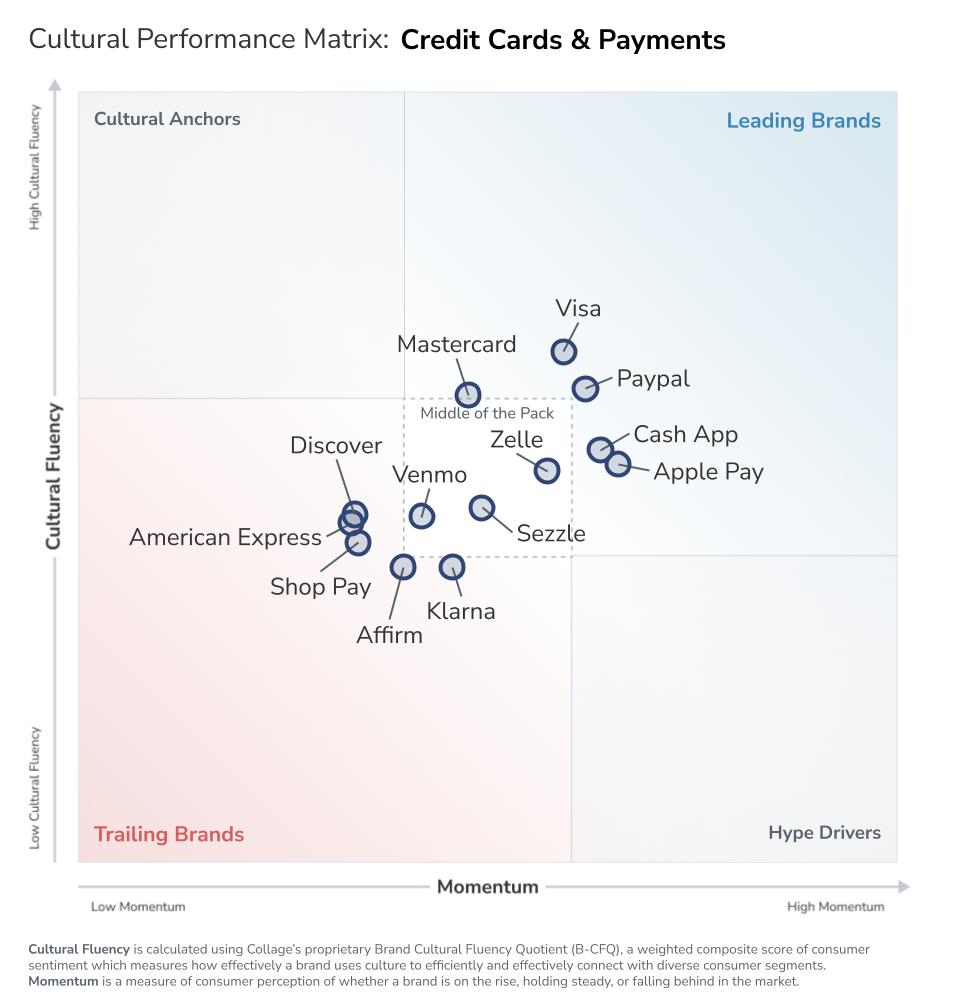
Visa, PayPal, Apple Pay, and Cash App lead in cultural fluency, while American Express, Discover, and BNPL (Buy Now, Pay Later) pioneers risk falling out of touch.
In the financial services sector, the traditional moat of security, scale, rewards, and status are no longer enough to protect market share. As consumers move away from legacy banking relationships toward integrated digital ecosystems, the category is shifting from functional competition to cultural competition.
Transaction speed, points, and fraud protection are now table stakes. The brands pulling ahead are winning through cultural fluency — the ability to become part of how people live, shop, travel, split bills, and express identity across diverse audiences. They are earning more than share of wallet; they are earning share of identity.
This analysis uses Collage Group’s Cultural Performance Matrix, built from surveying thousands of U.S. consumers, to measure how effectively payment brands connect across race, ethnicity, generations, and sexual orientation, and which brands are becoming the future of the category versus those at risk of falling out of touch.
Key Findings:
The current landscape reveals that category leaders like Visa and PayPal are dominating because they have successfully transcended their roles as mere utilities to become cultural essentials. Their advantage lies in their incredible cultural breadth; by resonating consistently across every generation, from Gen Z digital natives to Boomers seeking reliability, they have secured a high-momentum position that makes them the bedrock of the modern payment ecosystem.
At the same time, a new class of digital natives is capturing the cultural zeitgeist by signaling more than just a transaction. Brands like Apple Pay and Cash App have aligned themselves with a lifestyle of “tactical agility.” They have become particularly foundational for younger, multicultural audiences who view instant access and seamless integration not just as features, but as reflections of their personal identity.
Conversely, legacy giants and newer innovators alike are finding themselves at a cultural crossroads. American Express and Discover currently face a sobering reality with momentum stalling. Despite their deep history, these brands are struggling with lower consumer resonance and risk fading into “utilitarian afterthoughts” if they cannot bridge the gap with the New American Mainstream.
What Payment Leaders Should Do Next
Leading Brands
Already commanding the lead – but the challenge is conversion to long-term dominance. These brands must identify the specific cultural signals fueling their momentum to prevent “vibe shift” disruptions.
For example, while Apple Pay leads in frictionless utility, the opportunity lies in deepening connection with segments that still value traditional fiduciary trust, a space where PayPal currently holds a more structured edge.
Middle of the Pack
Brands like Zelle and Sezzle sit in the neutral zone. They are functional and safe, but they lack the cultural energy necessary to drive organic growth. They are being “squeezed” by the high-momentum tech giants and the scale of legacy leaders.
For example, Zelle has the reach, but often lacks the “brand love” or community-centric identity seen in competitors like Cash App, leaving it vulnerable to being replaced as soon as a more “culturally relevant” alternative gains a foothold in its user base.
Trailing Brands
These brands have the most to gain by reframing their story. The priority is not more “cash back” offers, but rebuilding relevance for a new American mainstream that values instant access and inclusivity over exclusive, legacy prestige.
For example, American Express and Discover need to move beyond their current momentum by proving they can keep pace with the expectations of diverse Gen X and Gen Z consumers who view financial tools as extensions of their digital identity, not just plastic in a wallet.
The Bottom Line
In the payments space, you aren’t just competing on meaning as much as you are on interest rates. In a world where the transaction itself is invisible, the brands that win are the ones that remain visible in the consumer’s culture.
This is why we launched the Cultural Performance Matrix™, to provide an objective way for financial brands to understand where they stand, where they are vulnerable, and how to turn cultural insight into a measurable competitive advantage.
Dive Deeper into the Rankings
If you want to dive deeper into the specific cultural factors separating Credit Card and Payments Powerhouses from the rest of the pack, fill out the form to download our briefing.
About the Cultural Performance Matrix
The Cultural Performance Matrix™ is anchored in Collage’s proprietary Brand Cultural Fluency Quotient (B-CFQ), which measures how effectively a brand connects across diverse consumer segments – based on drivers like fit, relevance, trust, values, memories, and advocacy. Combined with market momentum – an indicator of whether a brand is gaining or losing traction – the framework provides a dynamic view of performance, helping brands understand not just how they are perceived, but how that perception translates into real-world traction. Brands that improve their ranking on the Matrix consistently see gains in favorability and purchase intent.
This particular study is based on survey data from 4,500 U.S. consumers.