Cultural Performance Matrix: Grocery & Supermarket
The Grocery Divide – Why Cultural Fluency Is the New Playbook for Differentiation and Growth
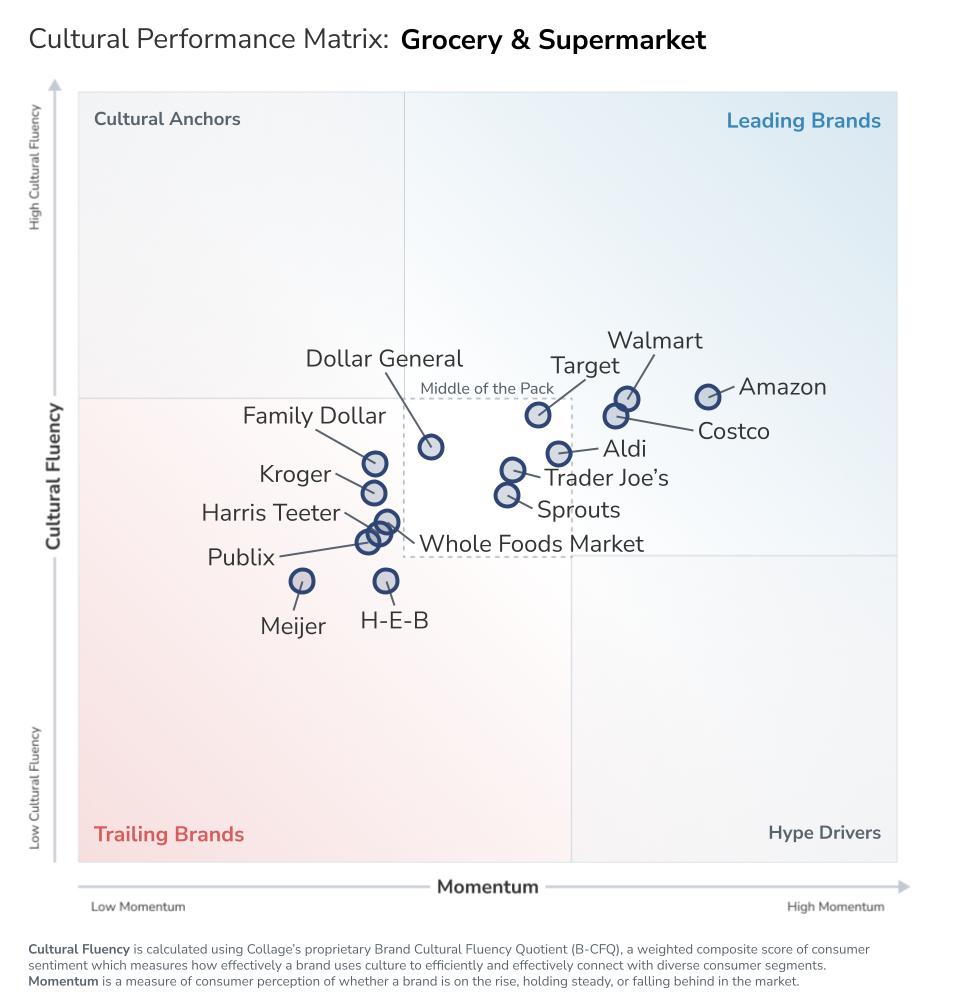
Walmart, Amazon, and Costco lead in cultural fluency, while Kroger, Publix, Aldi, and Target risk falling out of touch.
Across grocery retail, the playbook that built category leaders is starting to break down. Operational factors like price, proximity, and scale still matter, but they are no longer sufficient to separate retailers who grow from those who stagnate.
Instead, a new playbook is emerging. Rather than competing on functional utility and racing toward commoditization, leading retailers are separating based on cultural fluency – their ability to connect effectively across diverse consumers – and gaining share and maintaining pricing power as a result.
This analysis is based on Collage Group’s Cultural Performance Matrix, built from surveying thousands of U.S. consumers to understand how brands connect across diverse audiences. It captures not just overall sentiment, but how consistently brands resonate across different cultural groups, generations, and identities.
Key Findings:
Amazon, Walmart, and Costco are leading because they reflect how people actually live and what they care about. Their advantage isn’t just depth – it’s cultural breadth. They resonate consistently across generations – from Gen Z to Boomers – and across diverse consumer segments spanning race, ethnicity, gender, and sexual orientation.
By contrast, “Trailing Brands” like Kroger and Publix risk falling out of touch -competing on commoditized factors like price and convenience, while struggling to build the cultural fluency and momentum needed to differentiate.
Meanwhile, Target and Aldi sit in the middle – showing elements of cultural fluency and momentum, but lacking the consistency across audiences needed to sustain growth.
While the Cultural Performance Matrix is designed to measure cultural performance – not financial outcomes – we observed a pattern when comparing two-year sales performance across retailers, Retailers with the strongest cultural performance cluster within a tighter band of low double-digit growth, while the middle and trailing groups show significantly wider dispersion – from negative growth to double-digit gains.
This variance suggests that leaders are building more stable, repeatable demand, while others rely more on pricing, promotions, or isolated strengths to drive performance.
What Retailers Should Do Next
Leading Brands
Already strong – but not always fully aware of what’s driving that strength. The opportunity is to double down: identify which audiences and cultural signals are fueling momentum, and where relevance can be extended further to sustain growth.
For example, Walmart, while outperforming the category across most multicultural audiences and generations, shows a relative gap with Asian consumers – where competitors like Costco hold an edge – highlighting a clear opportunity to strengthen resonance and close a competitive vulnerability.
Middle of the Pack
This is the most at-risk group. They are being squeezed from both sides and risk sliding into commoditization. The path forward requires a clear strategic choice -either lean into cultural differentiation to build preference or compete more aggressively on value. Trying to do both is what keeps them stuck.
For example, Target’ssolid overall performance masks meaningful drop-offs across key multicultural audiences and younger consumers, leaving it without the consistency across segments needed to sustain momentum
Trailing Brands
These retailers have the most to fix – and the most to gain. The priority is not more promotions or price investment, but rebuilding relevance: understanding where connection has been lost and how to re-engage in ways that build trust and meaning – not just transactions.
For example, Kroger’s significantly lower momentum (27% vs. Walmart’s 49%), combined with underperformance among acculturated Hispanic consumers and notable weakness with Gen X, leaves it without a clear audience where it can anchor growth.
The Bottom Line
Grocery retailers aren’t just competing on price anymore – they’re competing on meaning. And in a category where everything looks the same, the brands that win are the ones that connect.
This is why we launched the Cultural Performance Matrix™ – to provide an objective way for brands to understand where they stand, where they are vulnerable, and what it will take to turn cultural insight into a measurable competitive advantage.
Over the coming weeks and months, we will be publishing Cultural Performance Matrices across additional verticals.
Dive Deeper into the Rankings
If you want to dive deeper into the specific cultural factors separating Grocery Cultural Powerhouses from the rest of the pack, fill out the form to watch our Deep Dive video.
About the Cultural Performance Matrix
The Cultural Performance Matrix™ is anchored in Collage’s proprietary Brand Cultural Fluency Quotient (B-CFQ), which measures how effectively a brand connects across diverse consumer segments – based on drivers like fit, relevance, trust, values, memories, and advocacy. Combined with market momentum – an indicator of whether a brand is gaining or losing traction – the framework provides a dynamic view of performance, helping brands understand not just how they are perceived, but how that perception translates into real-world traction. Brands that improve their ranking on the Matrix consistently see gains in favorability and purchase intent.
This particular study is based on survey data from 4,500 U.S. consumers.