Cultural Performance Matrix: Quick Serve Restaurants (QSR)
The QSR Divide – Why Cultural Fluency is the New Playbook for Quick-Service Restaurant Loyalty
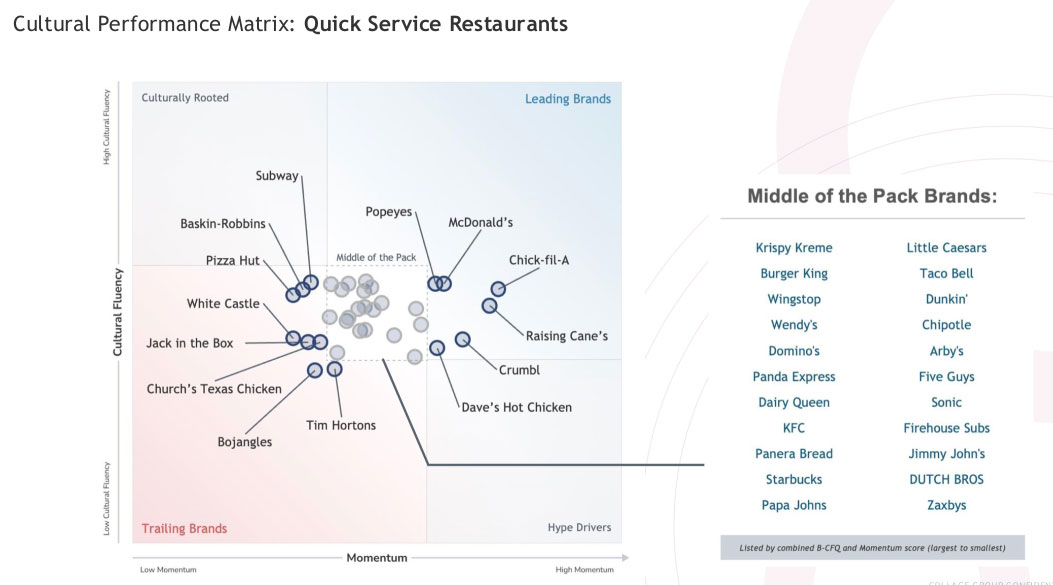
Chick-fil-A, McDonald’s, and Raising Cane’s lead in cultural fluency, while Pizza Hut, Subway, and White Castle are at risk of falling out of touch.
While Quick Service Restaurants (QSR) have historically prioritized speed and convenience, the playbook for industry leadership is shifting. Operational excellence – such as having the most locations or the fastest drive-thru – remains table stakes, but it is no longer the primary driver of differentiation. Instead, the brands winning today are those that have successfully balanced high market momentum with deep, consistent cultural fluency.
Consumer resonance is replacing the era of “one size fits all” fast food as the primary currency for growth. Rather than competing on price alone, leading QSRs are separating themselves by how effectively they navigate the shifting cultural expectations of a diverse and demanding consumer base. In this high-stakes environment, the distance between being a routine stop and a cultural destination is measured by a brand’s ability to stay “on the rise” in the eyes of the new American mainstream.
This analysis is based on Collage Group’s Cultural Performance Matrix, built from surveying thousands of U.S. consumers to understand how brands connect across diverse audiences. It captures not just overall sentiment, but how consistently brands resonate across different cultural groups, generations, and identities.
Key Findings:
The QSR sector currently reflects a “Barbell Economy” of performance, where powerhouse brands like Chick-fil-A and McDonald’s dominate the leading quadrant. These industry giants have successfully scaled their cultural resonance alongside their massive physical footprints, maintaining competitive B-CFQ scores while convincing consumers that they are still moving forward. Raising Cane’s joins this elite group with exceptional market energy, proving that a focused menu backed by strong cultural signals can define the industry’s current growth trajectory.
Simultaneously, a new wave of challengers is capturing the zeitgeist by prioritizing vibe over sheer scale. Brands like Dave’s Hot Chicken and Crumbl are performing well above their weight, proving that high momentum can be achieved even while building up their foundational B-CFQ scores. These brands have successfully aligned themselves with a sense of “tactical agility” and discovery that resonates deeply with younger, multicultural audiences who are eager for brands that feel like they belong to the current cultural moment.
Conversely, legacy scale is no longer a shield against stagnation for the “Trailing Brands” of the category. Pizza Hut, Subway, and White Castle are all facing a significant deficit in market energy. Even Subway is struggling to translate that legacy relevance into a positive growth trajectory. These brands aren’t suffering from a lack of awareness, but from a lack of perceived progress. They risk becoming culturally sidelined as they become associated with the past rather than the future.
What QSR Leaders Should Do Next
Leading Brands
Already strong, these brands must maintain their “velocity” without losing the “breadth” that made them leaders. The opportunity is to identify which specific cultural segments are fueling their momentum and protect those flanks from high-energy challengers.
For example, while McDonald’s ranks slightly higher than Chick-fil-A, the latter’s superior momentum suggests it is currently viewed as more “on the rise,” highlighting a need for McDonald’s to re-energize its cultural signals to avoid appearing “steady” rather than “surging.”
Middle of the Pack
This group, including Wendy’s, KFC, and DairyQueen, is home to the industry’s “sleeping giants.” Their rankings indicate foundational consumer trust, yet only about a quarter of consumers believe these brands have positive momentum. They are perfectly positioned to jump into the top-tier if they can find a way to re-inject energy into their marketing.
For example, Wendy’s has the foundational resonance required to dominate, but currently lacks the market energy seen in top-tier performers. To avoid being eclipsed by high-momentum challengers, they must convert their high cultural relevance into visible, high-energy market movement.
Trailing Brands
These brands face the largest relevance gap to close. The priority is not just more locations or digital coupons, but rebuilding a sense of movement and meaning. They must address their negative momentum quickly to prove they can keep pace with a fast-moving category.
For example, Subway and Pizza Hut must leverage their high B-CFQ as a safety net to take bigger risks. High resonance won’t protect a brand forever if the perception remains that they are “falling behind” the cultural core.
The Bottom Line
QSR brands aren’t just competing on calories and convenience – they’re competing on cultural velocity. In a category where speed is a given, the brands that win are the ones that move at the speed of culture.
This is why we launched the Cultural Performance Matrix™ to provide an objective way for brands to understand where they stand, where they are vulnerable, and what it will take to turn cultural insight into a measurable competitive advantage.
Dive Deeper into the Rankings
If you want to dive deeper into the specific cultural factors separating QSR Powerhouses from the rest of the pack, fill out the form to download our briefing.
About the Cultural Performance Matrix
The Cultural Performance Matrix™ is anchored in Collage’s proprietary Brand Cultural Fluency Quotient (B-CFQ), which measures how effectively a brand connects across diverse consumer segments – based on drivers like fit, relevance, trust, values, memories, and advocacy. Combined with market momentum – an indicator of whether a brand is gaining or losing traction – the framework provides a dynamic view of performance, helping brands understand not just how they are perceived, but how that perception translates into real-world traction. Brands that improve their ranking on the Matrix consistently see gains in favorability and purchase intent.
This particular study is based on survey data from 4,500 U.S. consumers.