Cultural Performance Matrix: Social Media

Why social media advertising must be planned by cultural relevance, not just reach


Cultural Relevance Is Redefining Social Media Platforms


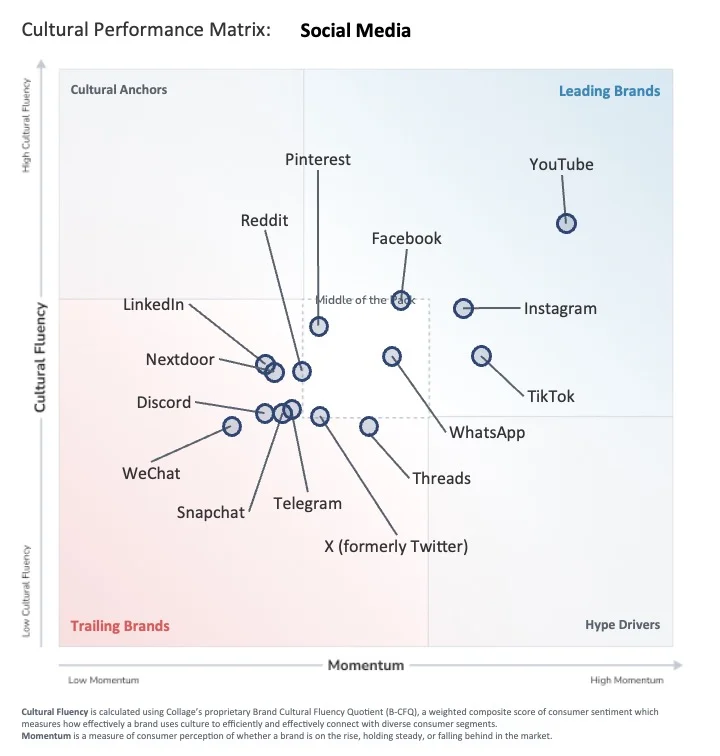
YouTube, Instagram, Facebook, TikTok, WhatsApp, and Pinterest all show cultural relevance strength in Collage Group’s latest Cultural Performance Matrix™, but they do not win in the same way. Each platform plays a different cultural job for a different audience, and that matters for both social platforms and the advertisers investing in them.

As digital spaces become more fragmented, the old social media playbook of prioritizing user count and reach is no longer enough. Scale still matters, but it does not explain which platforms feel culturally current, which ones create momentum, and which ones simply remain useful.

Today’s consumers are not only choosing networks for function. They are choosing platforms that reflect their identities, habits, communities, aspirations, and sense of belonging. That is why cultural relevance has become a more revealing measure of platform health than reach alone.

Collage Group’s Cultural Performance Matrix maps social media brands across two forces: Brand Cultural Fluency Quotient, or B-CFQ, and Momentum. B-CFQ measures how effectively a brand connects across diverse consumer segments. Momentum captures whether consumers perceive the brand as rising, steady, or falling behind. Scores are measured on a 0-100 scale.

In this article, cultural relevance refers to B-CFQ performance.

The Headline: YouTube Leads, But The Drivers Are Not Uniform

At the aggregate level, YouTube is the clear category leader. It ranks first in B-CFQ overall and remains the top B-CFQ brand across every generation and multicultural segment studied. It is also positioned firmly in the matrix’s Leading Brands quadrant, with both high cultural fluency and high momentum.

That makes YouTube the category’s rare universal anchor. It is not being carried by a single audience pocket. Its strength is broad-based, spanning Gen-Z, Millennials, Gen-X, Boomers+, Asian, Black, White, and Hispanic audiences, including US-Leaning, Bicultural, and Heritage-Leaning Hispanic segments.

But the story becomes more strategically useful once we look beneath the aggregate ranking. Instagram, TikTok, Facebook, WhatsApp, Pinterest, and Reddit all become more interesting when viewed through the audience lens. Their value depends less on whether they are simply “leaders” or “laggards,” and more on which cultural job they perform for specific consumers.

A Better Planning Lens: Each Platform Has A Cultural Relevance Advantage

A closer look at what is driving each platform’s position in the matrix shows that social platforms are not interchangeable media placements. They operate more like cultural environments, each with a different role in how consumers discover, validate, share, plan, and participate.

The chart below shows why aggregate rankings can hide important opportunities. YouTube leads broadly, but different audiences reveal different platform strengths. Instagram and TikTok become more important in younger cultural contexts. WhatsApp becomes especially important with Hispanic Heritage-Leaning and Bicultural audiences. Facebook remains highly relevant with older audiences and family/community contexts. Pinterest shows strength in audiences and moments connected to planning, inspiration, and intent.
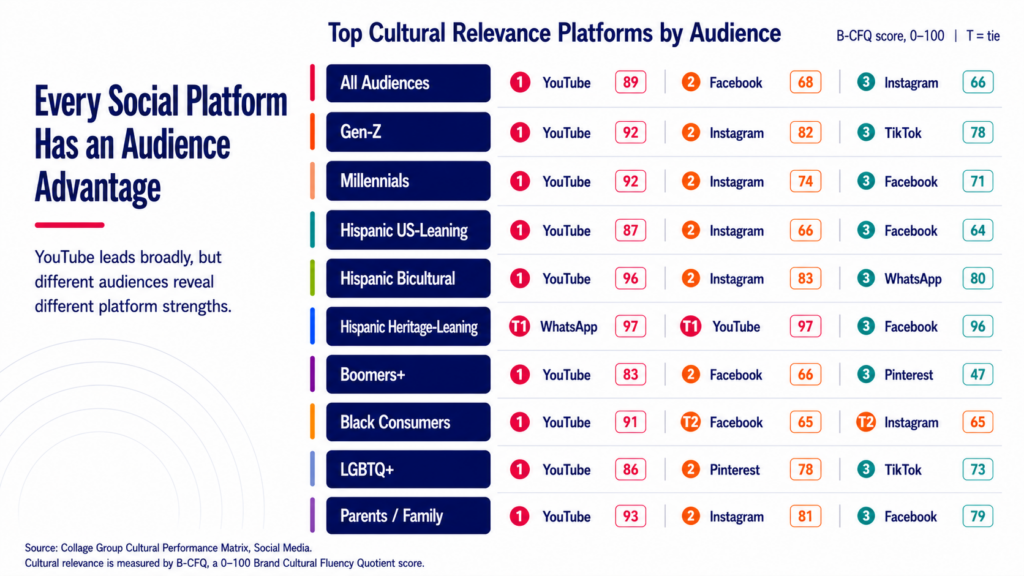
This is the central strategic shift: advertisers should not only ask which platform has the most reach. They should ask which platform has the right cultural permission for the audience and objective.


What The Segment Data Reveals

Generational and multicultural breakouts show why aggregate rankings can be misleading if marketers stop at the top line.

  • YouTube

    is the only universal leader. It ranks first across every major generation and multicultural split, making it the safest anchor for broad cultural relevance.

  • Instagram

    is strongest where culture moves visually and socially. It overperforms with Gen-Z, Millennials, and Hispanic audiences, but is less universal among older audiences.

  • TikTok

    has an aggregate rank that understates its youth importance. It is much stronger with Gen-Z and Hispanic Heritage-Leaning audiences than with Boomers+ or older cohorts.

  • WhatsApp

    is a hidden Hispanic driver. It ties YouTube for the top B-CFQ score among Hispanic Heritage-Leaning consumers and ranks highly among Bicultural Hispanic consumers.

  • Facebook

    is culturally durable, not culturally flashy. It remains strong with older generations, family/community contexts, and Hispanic audiences, but it is not the same momentum engine for Gen-Z.

  • Pinterest

    is a quiet cross-segment performer. It rarely dominates, but it shows enough consistency to matter in inspiration, planning, and purchase-adjacent moments.

Implications For Brand Advertisers

For advertisers, the biggest takeaway is that platform selection should be based on audience, objective, and cultural role, not just reach or cost efficiency.

  • Use YouTube when a campaign needs broad trust, cultural legitimacy, creator storytelling, education, or cross-generational scale.
  • Use Instagram and TikTok when the objective is cultural velocity, visual identity, youth relevance, creator discovery, or trend participation.
  • Use WhatsApp more intentionally for Hispanic Bicultural and Heritage-Leaning audiences, especially where community sharing, referral, customer service, or conversational commerce matter.
  • Use Facebook for older audiences, family networks, local community, retargeting, events, and trust-based conversion rather than as a pure youth-culture signal.
  • Use Pinterest when consumers are planning, imagining, comparing, or moving toward purchase in categories like beauty, home, food, fashion, wellness, parenting, and seasonal moments.
  • Use Reddit, Discord, Snapchat, Telegram, WeChat, Threads, X, and Nextdoor selectively, with audience-specific logic and creative that respects the platform’s community norms.

Implications For Social Platforms

For social platforms themselves, the strategic mandate is not simply to become more culturally fluent in a generic sense. It is to understand which audiences are granting the platform cultural permission, and then protect or expand that role.

  • Platforms with broad leadership need to defend their source of momentum. YouTube, Instagram, and TikTok should track which audiences are generating the strongest cultural lift and avoid flattening their brands into one-size-fits-all relevance.
  • Platforms with more specific strengths need a sharper audience role. Pinterest, Reddit, Facebook, and WhatsApp should not necessarily chase the same kind of cultural heat as TikTok. Their advantage may be intent, trust, community, or depth.
  • Platforms with more selective relevance need to prove they are more than utilities. LinkedIn, Snapchat, Discord, X, Threads, Telegram, WeChat, and Nextdoor may still have meaningful functional use cases, but utility alone does not guarantee cultural resonance.
  • Audience-specific strength should become product and marketing strategy. WhatsApp’s Hispanic strength, TikTok’s Gen-Z strength, Facebook’s family/community relevance, and Pinterest’s planning role are not just media facts. They are platform positioning opportunities.
The Bottom Line


Social platforms are now competing for meaning, not just screen time. The winners are not merely the largest networks. They are the platforms that consumers believe understand their culture, reflect their communities, and still feel like they are moving forward.

For platforms, that means cultural fluency must be managed as a strategic asset. For advertisers, it means the smartest media plans will no longer ask only where an audience can be reached. They will ask what cultural job each platform performs for that audience, and whether that job matches the brand’s message, moment, and ambition.

Request a Deep Dive

If you want to dive deeper into the specific cultural factors separating Social Media Leaders, fill out the form to schedule a 20-minute consultation with our cultural strategists.

About the Cultural Performance Matrix

The Cultural Performance Matrix™ is anchored in Collage’s proprietary Brand Cultural Fluency Quotient (B-CFQ), which measures how effectively a brand connects across diverse consumer segments – based on drivers like fit, relevance, trust, values, memories, and advocacy. Combined with market momentum – an indicator of whether a brand is gaining or losing traction – the framework provides a dynamic view of performance, helping brands understand not just how they are perceived, but how that perception translates into real-world traction. Brands that improve their ranking on the Matrix consistently see gains in favorability and purchase intent.

This particular study is based on survey data from 4,500 U.S. consumers.