
Skyward Bound: How Airlines Are Winning (Or Losing) Gen Z’s Cultural Loyalty

The Quick Read:
- Cultural connection is reshaping airline competition: Gen Z travelers are looking beyond ticket prices, creating opportunities for airlines that align with their expectations, values, and experiences.
- Strong brands still have room to grow: Delta Airlines maintains a leading cultural position among Gen Z, but Southwest’s recent momentum highlights opportunities for established airlines to continue strengthening their connections with younger travelers.
- Low-cost operators have an opportunity to build loyalty: Frontier Airlines’ improving cultural performance suggests that value-driven carriers can strengthen their relationships with younger travelers.
Navigating the Gen Z Horizon
Over an 18-month period leading up to August 2026, the airline industry experienced a pronounced cultural realignment among Gen Z travelers. As young consumers prioritize experiential travel over material goods, airlines find themselves evaluated through a far more rigorous lens than basic route schedules or ticket pricing. Cultural affinity, shared values, and seamless digital interaction increasingly influence consumer choice, transforming air travel from a commoditized transaction into an active expression of identity.
Collage’s Brand Cultural Fluency Quotient (B-CFQ) measures how effectively brands connect with consumers through cultural relevance. By examining both current brand performance and changes over time, the research reveals which airlines are strengthening their relationships with Gen Z and which risk falling behind.
Our analysis of brand performance reveals an industry in active motion, with an average 18-month velocity shift of +6.9pp across major carriers. While legacy giants maintain strong foundational equity, nimble competitors are capitalizing on shifting consumer expectations. The gap between carriers expanding their cultural moat and those coasting on legacy reputation is widening rapidly.
Strategic Breakdown: Brand Positioning Across Quadrants
Strong Now, Gaining Ground
Carriers in this quadrant possess robust cultural equity alongside strong growth velocity, expanding their market footprint while entrenching consumer affinity.
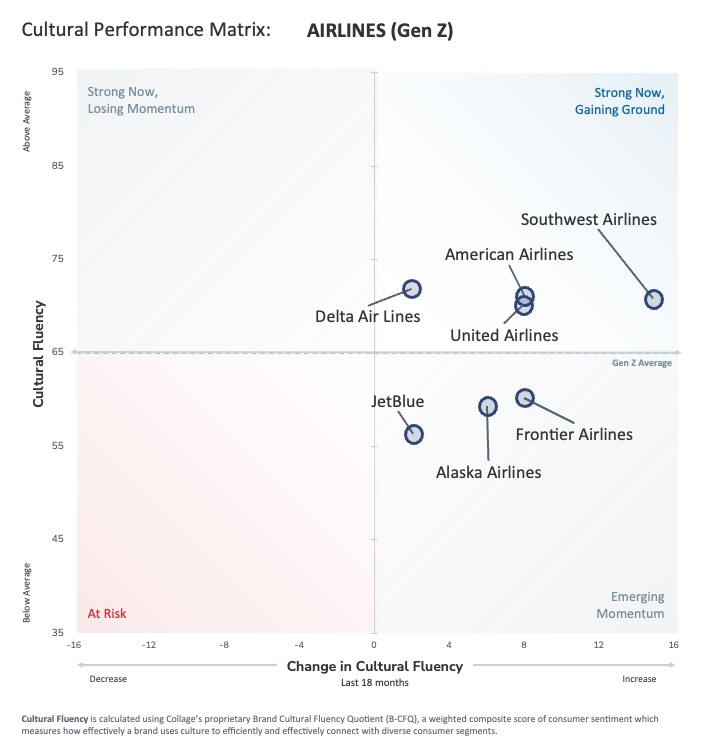
- Delta Air Lines (B-CFQ: 72, 18-Month Change: +2pp) maintains a strong position among Gen Z travelers, supported by high trust and operational reliability. While its 18-month growth has been more modest than some competitors, its established cultural equity provides a strong foundation for continued engagement with younger consumers.
- Southwest Airlines (B-CFQ: 72, 18-Month Change: +15pp) leads the industry in growth trajectory. By aligning closely with Gen Z’s demand for flexibility, unbundled value, and approachable service, Southwest’s high fit and advocacy scores drove a massive surge over the last 18 months.
- American Airlines (B-CFQ: 71, 18-Month Change: +8pp) and United Airlines (B-CFQ: 70, 18-Month Change: +8pp) both successfully expanded their cultural resonance. Strong scores in trust and relevance paired with modernized digital touchpoints allowed both legacy operators to capture steady velocity.
Emerging Momentum
- Frontier Airlines (B-CFQ: 60, 18-Month Change: +8pp) is building cultural equity rapidly. Though starting from a lower baseline, comparatively higher peer-to-peer advocacy and price-to-value alignment propelled the carrier upward, signaling a clear opportunity to convert budget-conscious flyers into long-term loyalists.
- Alaska Airlines (B-CFQ: 59, 18-Month Change: +6pp) demonstrates steady upward trajectory. While its regional focus limits overall advocacy compared to national giants, stronger trust among younger consumers provides a stable platform for strategic expansion.
- JetBlue (B-CFQ: 56, 18-Month Change: +2pp) occupies a precarious position at the bottom of the index. Lacking both high absolute cultural resonance and meaningful forward velocity, low scores across values and brand fit indicate that its historic reputation as a customer-favorite boutique carrier is eroding among younger demographics.
What Airline Brands Can Learn from Gen Z’s Shifting Loyalty
Align With Gen Z’s Expectations: Brands sitting in low-growth positions, like JetBlue, need to strengthen their connections with younger travelers by focusing on transparency, value, and digital experiences.
Turn Advocacy Into Growth: High-velocity brands can build on positive word of mouth through authentic content, customer experiences, and community-driven marketing campaigns.
Cultivate Trust to Sustain Loyalty: Emerging momentum carriers, like Frontier, should pair their growing appeal with reliable service to turn short-term interest into lasting loyalty.
Build on Established Brand Strength: Leading airlines, like Delta, have an opportunity to build on their strong reputations by continuing to evolve alongside Gen Z’s changing expectations and preferences.
About This Report: This post was drafted using AI-assisted technology. The underlying data is sourced from Collage Group’s primary B-CFQ research; the narrative analysis is mapped through our Industry Performance Matrix to highlight immediate strategic opportunities.
Is your brand keeping pace with changing consumer expectations? Discover how Collage’s cultural intelligence can help you understand what’s driving brand relevance, identify competitive opportunities, and build stronger consumer connections. Connect with us today.