
The Price of Losing Trust: Why Cultural Resonance Matters in Wealth Management

Trust has always been central to wealth management. But for brands competing to win Gen Z, reputation and recognition alone may no longer be enough.
As younger consumers develop relationships with financial brands, cultural relevance is becoming an important competitive advantage. The question for wealth management marketers is whether their brands are building the connections needed to earn Gen Z’s trust.
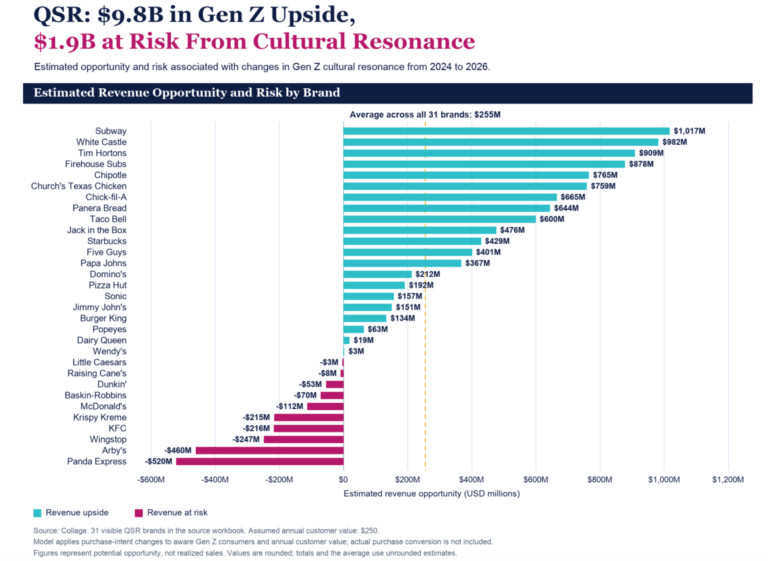
Culture Converts, a new report from Collage and the ANA Cultural Leadership Alliance, examines the financial impact of changes in cultural resonance between 2024 and 2026 across 134 brands in four industries.
In the the wealth management category alone, the findings identify $38.2 billion in combined modeled revenue opportunity and risk tied to shifts in Gen Z cultural resonance.
The Financial Opportunity Behind Cultural Resonance
Cultural resonance isn’t just a brand perception metric. It’s closely linked to whether consumers intend to choose a brand.
Collage’s research found that every one-point increase in Brand Cultural Fluency Quotient (B-CFQ), its measure of cultural resonance, corresponds to a .79% increase in purchase intent.
Across the 26 wealth management brands studied, changes in Gen Z cultural resonance between 2024 and 2026 were associated with $29.6 billion in modeled revenue opportunity and $8.6 billion in revenue opportunity at risk.
Going deeper, the findings reveal significant differences in how individual brands are positioned:

Robinhood: $5.1 billion in modeled revenue opportunity, supported by a 16.1-point increase in cultural resonance from 2024 to 2026.

Chase: $4.6 billion in modeled revenue opportunity, with cultural resonance increasing 9.5 points.

Charles Schwab: $1.8 billion in modeled revenue opportunity at risk following a decline in cultural resonance.
These estimates reflect potential opportunities associated with changes in cultural resonance, rather than actual revenue gained or lost.
But the numbers tell only part of the story. How brands are building cultural resonance with Gen Z is just as important as the financial opportunity itself.
Why Chase and Robinhood Are Gaining Ground With Gen Z
Chase and Robinhood offer two different examples of how wealth management brands can strengthen their position with Gen Z.
With 98% Gen Z brand awareness, Chase has an established advantage in recognition. But its growth in cultural resonance suggests the brand is doing more than relying on its name.
Chase also performs strongly on trust, with 81% of Gen Z consumers associating the brand with that attribute. Its brand favorability reaches 68%, compared with the wealth management category average of 47%.
Robinhood tells a different story.
Despite having just 64% Gen Z brand awareness, Robinhood recorded a larger increase in cultural resonance than Chase, translating to an estimated 12.7-percentage-point lift in purchase intent.
Together, these findings challenge the assumption that the most recognizable financial brands are necessarily best positioned to win younger consumers.
For established institutions, cultural resonance can strengthen an existing advantage. For challengers, it can create opportunities to compete even without the same level of recognition.
What This Means for Wealth Management Marketers
Gen Z’s relationship with financial brands is still taking shape, creating opportunities for institutions willing to rethink how they build connections.
Chase offers one example.
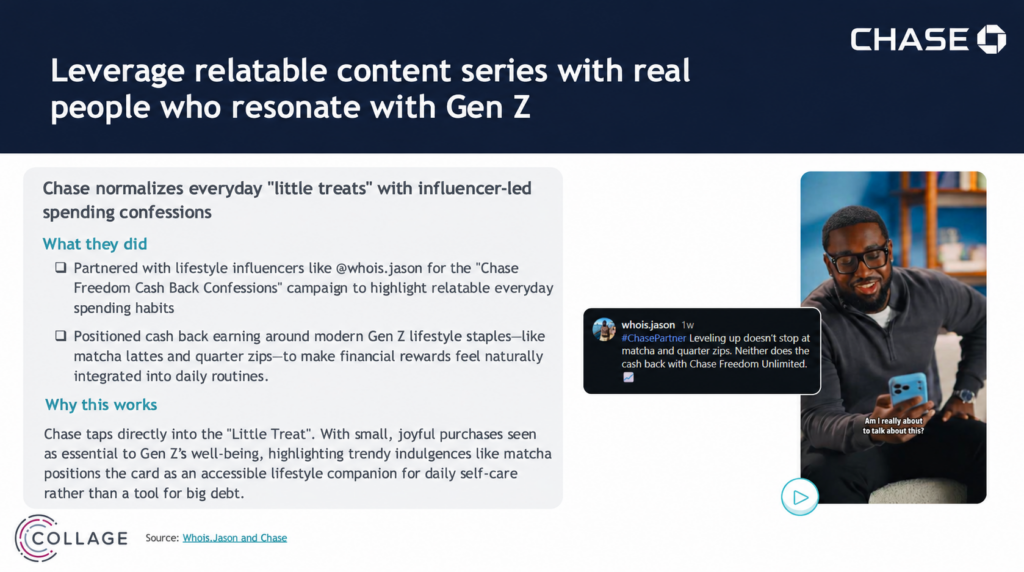
Its marketing brings financial products into everyday conversations, from creator-led content about spending habits to affordable experiences and sports partnerships. Rather than focusing exclusively on financial expertise, the brand finds ways to participate in the interests and communities that matter to younger consumers.
The broader takeaway is that financial credibility and cultural relevance need to work together.
For wealth management brands, that means understanding how Gen Z perceives their brand beyond awareness alone. Are they seen as trustworthy? Do they reflect consumers’ values? Are competitors building stronger connections?
The answers can reveal where brands have room to grow and where they may be falling behind.
Culture converts
What Could Cultural Resonance Be Worth to Your Brand?
Discover which wealth management brands are building stronger cultural resonance with Gen Z, where revenue opportunity may be at risk, and what these shifts could mean for your brand’s growth.