
The Cost of Losing Gen Z for QSR Brands: What Cultural Resonance Means for Category Growth
For quick-service restaurant (QSR) brands, winning over Gen Z consumers takes more than brand awareness. Even the most recognizable brands need to keep up with changing consumer expectations, and those that build stronger cultural connections have a real opportunity for growth.
And when that connection starts to fade, the financial stakes can be significant.
Culture Converts, a new report from Collage and the ANA Cultural Leadership Alliance, examines the financial impact of changes in cultural resonance between 2024 and 2026 across 134 brands in four industries.
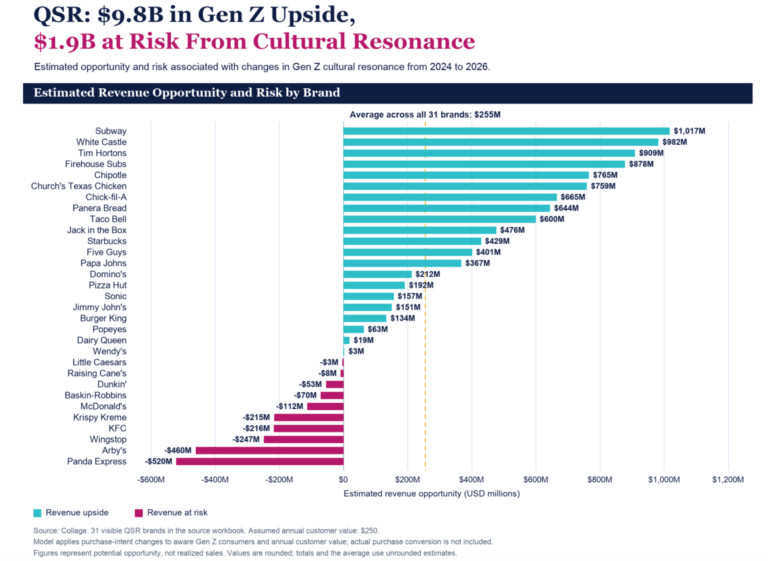
In the QSR category alone, the findings reveal $9.8 billion in modeled revenue opportunity associated with gains in Gen Z cultural resonance, alongside $1.9 billion in opportunity at risk from declines.
A closer look at established and challenger QSR brands reveals where those opportunities and risks are taking shape.
Established QSR Brands: Turning Cultural Resonance Into Growth at Scale
For established QSR brands, strong awareness can amplify the financial impact of gains in cultural resonance. With 98% awareness among Gen Z consumers, Subway illustrates just how significant that opportunity can be.
Between 2024 and 2026, the brand experienced a 7.5-point increase in cultural resonance, associated with approximately $1.0 billion in modeled incremental revenue opportunity, the highest among the QSR brands studied.

Even moderate improvements in resonance can represent substantial financial opportunity when a brand is familiar to nearly everyone in its target audience. The challenge is turning that familiarity into stronger reasons to choose the brand.
Challenger Brands: Punching Above Their Awareness
But high awareness isn’t a prerequisite for meaningful growth opportunities.
White Castle and Tim Hortons tell a different side of the story. Neither has the near-universal Gen Z awareness of Subway, yet both demonstrated significant modeled revenue opportunity associated with stronger cultural resonance.
- White Castle: $982 million in modeled incremental revenue opportunity, with 71% Gen Z awareness.
- Tim Hortons: $909 million in modeled incremental revenue opportunity, with 59% Gen Z awareness.

These results suggest that challenger brands don’t necessarily need to match the awareness of category leaders to build meaningful momentum.
For brands with smaller awareness footprints, the opportunity is to understand what’s driving cultural connection and build on it. Stronger resonance can help inform where to invest in expanding reach, strengthening engagement, and giving more consumers a reason to choose the brand.
When Cultural Resonance Declines, Revenue Opportunity Is At Risk
Not every QSR brand is moving in the same direction.
While Subway, White Castle, and Tim Hortons demonstrated opportunity associated with stronger cultural resonance, other brands saw declines that put potential revenue at risk.
The research identified:
- Arby’s: $460 million in modeled revenue opportunity at risk.
- Panda Express: $520 million in modeled revenue opportunity at risk.

These aren’t actual revenue losses. They represent modeled financial opportunity at risk associated with declining cultural resonance among Gen Z consumers.
Still, the findings raise an important question: What happens when a brand that consumers know begins to feel less relevant to them?
Changes in cultural resonance can offer an early indication that consumer perceptions are shifting. Understanding where that connection is weakening gives brands an opportunity to revisit the messaging, products, and experiences shaping how consumers perceive them.
And in a category where consumers have plenty of choices, maintaining cultural relevance matters.
What Cultural Resonance Looks Like in Practice: Chick-fil-A
Chick-fil-A offers an example of how QSR brands can build connections with Gen Z through culturally relevant marketing.
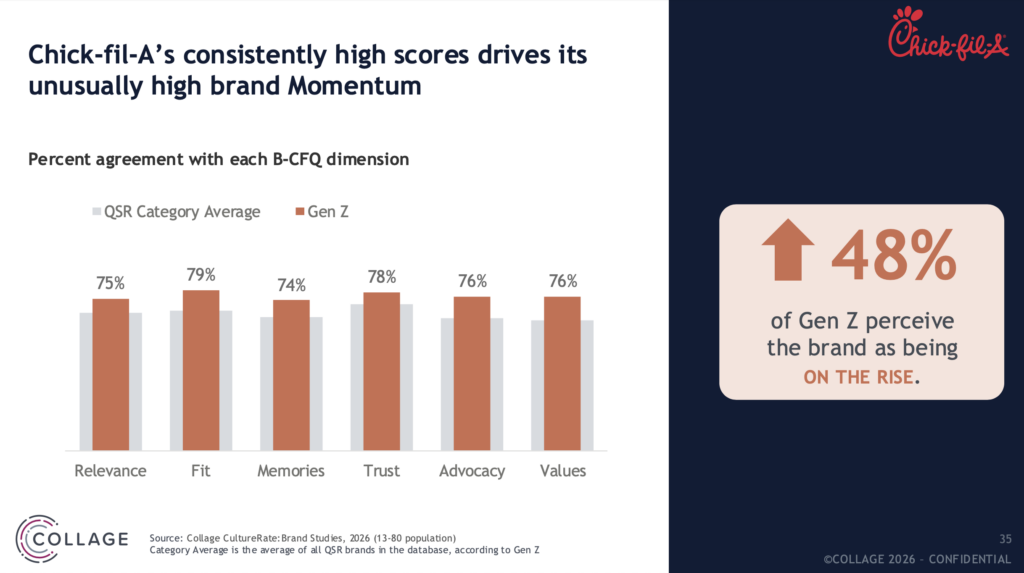
According to Collage’s research, 48% of Gen Z consumers perceive Chick-fil-A as a brand that’s “on the rise.” The brand also performs strongly across key dimensions of cultural relevance, including Relevance, Fit, Trust, and Values.
One way Chick-fil-A brings that cultural connection to life is by featuring its own Gen Z employees in ad content. Their ‘Working with Gen Z’ series uses lighthearted workplace humor, while other ads embrace Gen Z slang and offbeat memes.
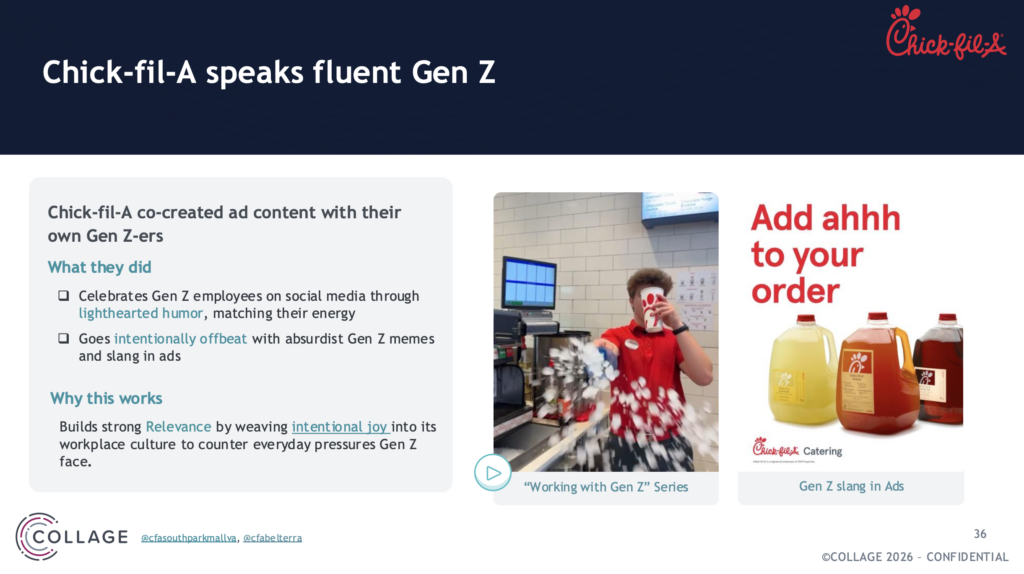
Rather than relying on traditional brand messaging alone, these examples show how cultural understanding can inform creative choices that resonate with Gen Z consumers.
Connecting Cultural Resonance to Financial Opportunity
Traditionally, marketers have measured brand awareness, consideration, and purchase intent to understand performance. Culture Converts adds another dimension by connecting cultural resonance to potential financial outcomes.
Collage’s Brand Cultural Fluency Quotient (B-CFQ) measures how well consumers perceive a brand as aligned with their identities and values. Our research identifies a relationship between changes in cultural resonance and purchase intent, with a one-point increase in cultural resonance corresponding to a 0.79% increase in purchase intent.
By combining this relationship with brand awareness and category-specific annual customer value assumptions, the Culture Converts model estimates the financial opportunity associated with stronger or weaker cultural resonance.
For QSR brands, understanding these shifts can help identify where cultural connections are creating opportunities for growth and where a changing relationship with Gen Z may put future opportunities at risk.
Culture converts
What Could Cultural Resonance Be Worth to Your Brand?
Discover which QSR brands are gaining ground with Gen Z, where revenue opportunity is at risk, and what cultural resonance could mean for your brand’s growth.