
How Cultural Fluency is Reshaping Gen Z’s Choice of Home Improvement Brands

As Gen Z reimagines home improvement, big-box leaders accelerate while specialized players risk fading into cultural irrelevance.
The Quick Read
- Digital convenience and modern DIY branding are widening the gap: Market leaders are consolidating dominance by actively translating home improvement into digital-first, lifestyle-driven experiences for younger consumers.
- Specialized retail faces severe headwinds without emotional resonance: Brands relying strictly on a functional legacy or single-category authority are losing traction as Gen Z demands broader utility and shared values.
- Cultural momentum requires balancing trust with social relevance: Maintaining market velocity requires continuous alignment with Gen Z’s evolving definition of how to build a home.
Industry Health & Cultural Dynamics
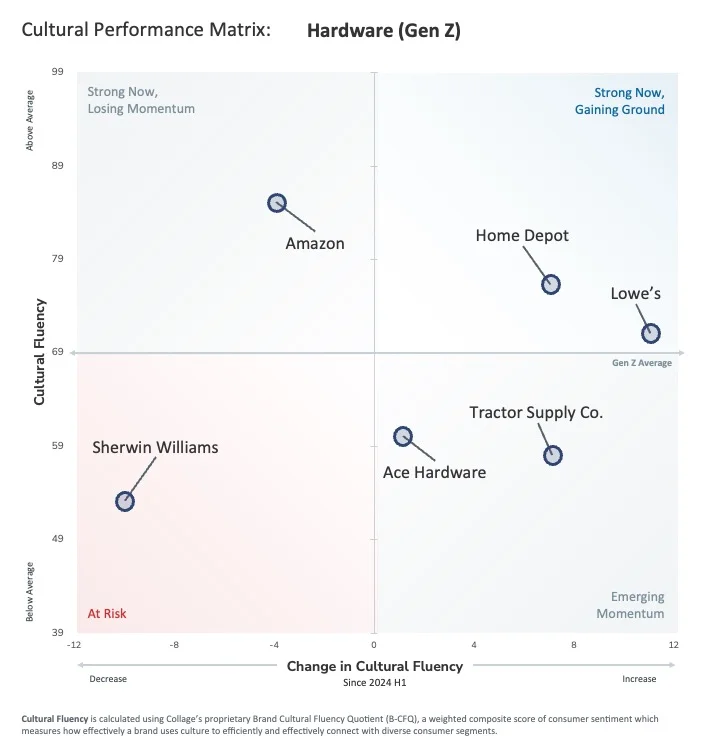
Overall industry health in the hardware sector reflects a dynamic reallocation of cultural equity rather than a sector-wide decline. A critical divergence has emerged between pure-play digital retail and physical big-box environments. While Amazon still leads in absolute baseline score (B-CFQ: 85), its momentum is slipping (Change: -4pp) as digital convenience alone loses its novel appeal. Conversely, physical powerhouses like The Home Depot (Change: +7pp) and Lowe’s (Change: +11pp) are surging forward by successfully combining physical project spaces with vibrant online DIY content ecosystems.
For executive leadership, the mandate’s clear: e-commerce access is merely the baseline entry fee, not a long-term differentiator. Pure digital utility without immersive physical engagement creates brand fatigue, whereas physical stores that lack digital inspiration risk total irrelevance among younger demographics. Winning in this space requires bridging tactile retail with digital lifestyle networks. Brands that master this hybrid model will capture sustainable market share and expand long-term cultural equity.
Strategic Takeaways for Hardware Brands
For hardware brands, the opportunity is to connect utility with cultural relevance. As Gen Z looks to digital content for project inspiration while still valuing physical retail experiences, brands that bridge those environments and align with the interests shaping how younger consumers approach their homes may be better positioned to build lasting cultural equity.
- Consolidate market leadership through lifestyle positioning: The Home Depot (B-CFQ: 76) and Lowe’s (B-CFQ: 71) demonstrate how big-box retailers can build cultural relevance among younger shoppers. Both brands have expanded their scores by securing a strong fit with Gen Z’s project-driven content creator ecosystem.
- Protect legacy advantage against cultural fatigue: While Amazon maintains the highest overall score in the sector (B-CFQ: 85), its recent growth trajectory displays early fatigue. Although Amazon benefits from strong consumer relevance and frictionless transactions, a lower values score indicates that concerns about its transactional nature may be influencing perceptions of the brand.
- Leverage niche authenticity to fuel velocity: Tractor Supply Co. (B-CFQ: 58) isn’t yet a leader in overall cultural fluency, but it is a breakout story in growth velocity (Change: +7pp). The brand may be tapping into rising Gen Z interest in homesteading, gardening, and rural lifestyle aesthetics, earning high trust alignment among this self-reliant cohort.
- Reignite neighborhood presence through community trust: Ace Hardware (B-CFQ: 60) remains flat in overall velocity (Change: 0pp). While its localized store model generates strong trust and customer service scores, an underperforming memories score among Gen Z consumers suggests an opportunity to strengthen its presence within digital-first discovery habits.
- Address specialized retail vulnerabilities immediately: Sherwin-Williams (B-CFQ: 53) experiences the sharpest decline in the industry (Change: -10pp), placing it firmly in the At Risk quadrant. While the brand maintains professional prestige, a low relevance score among Gen Z consumers highlights the challenge single-category destinations face when competing against all-in-one home improvement platforms.
About This Report: This post was drafted using AI-assisted technology. The underlying data is sourced from Collage Group’s primary B-CFQ research; the narrative analysis is mapped through our Industry Performance Matrix to highlight immediate strategic opportunities.
Contact us to learn how you can drive growth by leveraging Collage’s AI-enabled tools to engage subcultures.