
How Meijer Engaged Midwestern Sports Fans with Cultural Specificity to Gain a Competitive Advantage

Brands are competing in increasingly crowded categories, so traditional differentiators like price, distribution, and awareness are no longer enough. Our research at Collage shows that brands creating real cultural connections through cultural intelligence are better positioned to earn consumer trust, increase purchase intent, and build lasting loyalty.
For years, marketers relied on familiar levers to stand out: broad awareness campaigns, expansive distribution, and competitive pricing. Those fundamentals still matter, but they’re no longer enough to create meaningful differentiation. In today’s saturated marketplace, consumers have more choices than ever, making emotional connection, not simply visibility, a competitive advantage.
That shift is driving the importance of cultural specificity, which is possible with Collage cultural intelligence.
Rather than appealing to everyone with generalized messaging, brands–like Meijer–are finding more success by speaking authentically to the values, experiences, and identities of specific communities. Counterintuitively, the more specific the message, the broader its impact. When consumers recognize authentic storytelling rooted in real cultural experiences, it resonates beyond the intended audiences.
Cultural Resonance Drives Business Results
At Collage, we define cultural resonance as the degree to which a brand aligns with consumers’ values, identities, and lived experiences. It’s measured through six dimensions, including trust, relevance, advocacy, memories, values, and fit, that together create a picture of a brand’s cultural fluency. Cultural fluency is the ability to use cultural intelligence to efficiently and effectively connect across segments.
The business impact for brands is measurable. Research shows that every one-point increase in a brand’s cultural resonance score corresponds to a 0.79% increase in purchase intent. For marketers, that means improving cultural connection isn’t simply a branding exercise, it’s a growth strategy.
In a marketplace where many consumers already know a brand exists but haven’t chosen it, cultural resonance is the catalyst that moves them from awareness to consideration and ultimately conversion.
The Power of Understanding Subcultures
Consider younger Midwestern sports fans.
Sports fandom is obviously common across the U.S., but this particular audience is distinctive in how they create meaningful opportunities for brands. They are more likely than the average consumer to identify strongly with a favorite team, attend live games, host watch parties, purchase premium sports content, and actively engage with sports media. Soccer, esports, and international competitions are particularly popular among this group, reflecting both strong regional pride and a global outlook.
Just as important, these fans don’t just watch sports, they use them to build community. Sporting events become gathering places where shared experiences reinforce local identity and strengthen emotional connections.
For marketers, that represents more than a sponsorship opportunity. It offers a chance to become part of the community itself.
Meijer Shows What Cultural Specificity Looks Like
Regional retailer Meijer provides a compelling example of cultural specificity in action.
Rather than pursuing broad national sports partnerships, Meijer has invested deeply in the communities it serves. The retailer’s sponsorships with teams like the Detroit Red Wings, Detroit Tigers, and Cleveland Browns demonstrate visible support for hometown franchises. Beyond game day, Meijer extends that connection through locally relevant merchandise, charitable initiatives, and community programs that celebrate regional pride.
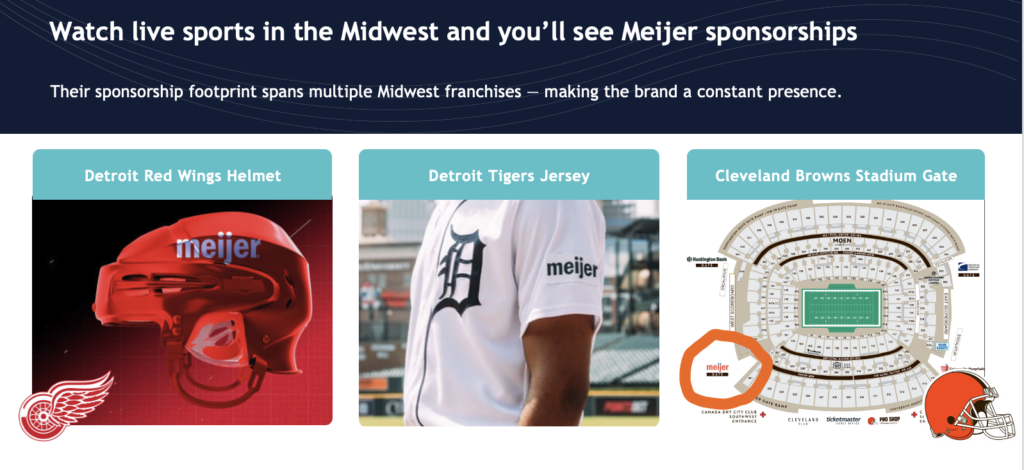
This approach transforms sports marketing from advertising into participation. By aligning with local traditions, supporting community organizations, and embracing the culture surrounding hometown teams, Meijer reinforces its role as more than a retailer, it becomes part of the community’s identity.
That kind of authenticity is difficult for competitors to replicate because it’s built on long-term relationships rather than one-time campaigns.
Three Takeaways for Marketers
As consumers seek brands that reflect who they are and what they value, cultural specificity is becoming an increasingly important driver of competitive advantage.
Marketers should keep three principles in mind:
- Lean into communities vs. demographics. Shared passions, identities, and cultural experiences can predict behavior more effectively than broad audience segments.
- Build ground level participation. Consumers recognize the difference between sponsorship and genuine community investment.
- Strategize locally. Brands that demonstrate a deep understanding of specific audiences often create stories that resonate far beyond those communities.
In an increasingly crowded marketplace, the brands that earn lasting loyalty won’t necessarily be the loudest. They’ll be the ones that make consumers feel understood. And increasingly, that begins with cultural specificity.
Contact us to unlock more insights on engaging subcultures with cultural specificity for growth.